Corespun Natural Stripes
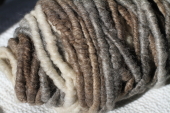
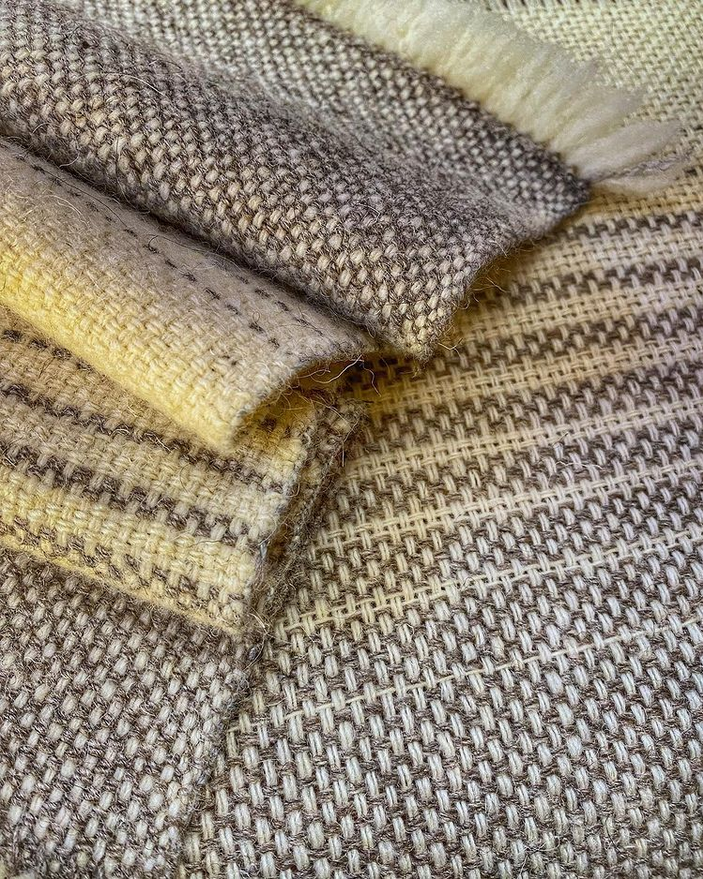
Corespun yarn in natural colors (white, brown, grey) spun to create 6-8 stripes per 2 pound bump. Fiber content: 50% mohair - 50% Shetland wool
Living with chickens, goats, sheep and wildlife on a small central NJ farm
Since the late 1990's I've run a small NJ farm producing 100% USA made, one of a kind fiber products. All products made using my animal's fiber or combined with other small USA farmer's fiber. Hand made in Hunterdon County, NJ with machine processing at small USA mills.
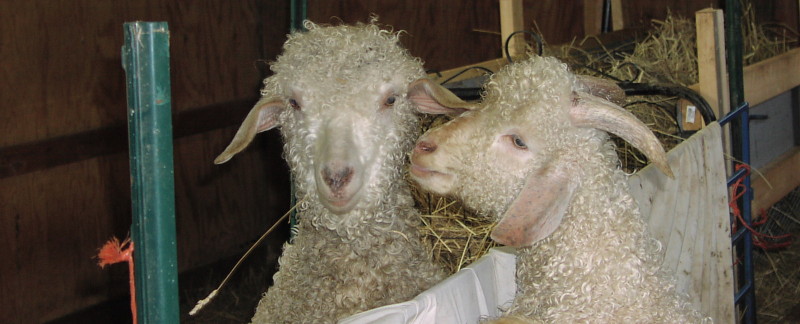
April 16, 2001 – April 5, 2016
Of natural causes, heart failure.
Ginger was a sweet, beautiful goat with one of the best fleeces I’ve ever had in my goats, the best of those with color genetics. Her father Sprout was a gorgeous goat and she got her great fleece from him, and the color gene from her mother Red. She passed the color genes on with great fleeces to her offspring too. She lived a great long life, serving as the herd matriarch until two days before her passing. She went downhill suddenly, enjoying life up til the last day or so. I opted to put her down as she was showing significant signs of distress – great difficulty breathing, she would not lie down and she stopped eating. The vet said she had never seen a case of heart failure in a goat, but she had a significant heart murmur and it was likely fluid around her heart that was causing her to have such difficulty breathing out. Also, laying down would have been painful because of the fluid in her chest. I believe that my goats are veterinary “experiments” because they live such long lives – most goats (or any livestock species) don’t get to live much past 2-5 years. Ginger died of natural causes – how often does that happen to livestock? She died with me holding her and she relaxed quickly and easily into an eternal peace.
It was so sad later in the afternoon when the other does went out to pasture because Ingrid came to the corner of the barn where Ginger had been for the last day and started calling for her. Ingrid had been standing on the partition and checking on Ginger while she was in a separate pen. She called and called until I went out and let her smell my hands since I had Ginger’s scent on my hands. I rolled Ginger (who was temporarily on a cart) to the pasture fence for Ingrid and the other does to smell. Then after a bit Ingrid and the others walked off, seeming to understand that Ginger would not be back. Ingrid did not cry for Ginger again.
Here as a memorial are some of my favorite photos of Ginger.
Ginger Wearing Bucket (Nov 2001)
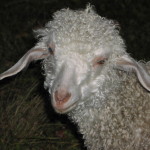
Ginger 7 Months Old (Nov 2001)
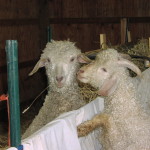
Ginger (left) and Scamp (2002)
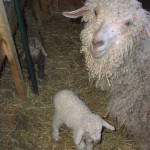
Ginger with Newborns Sienna and Jasmine (2003)
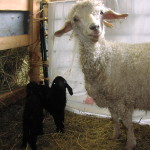
Ginger with Kids Leo and Rembaldi (2004)
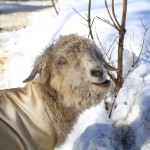
Ginger in the Snow (2014)
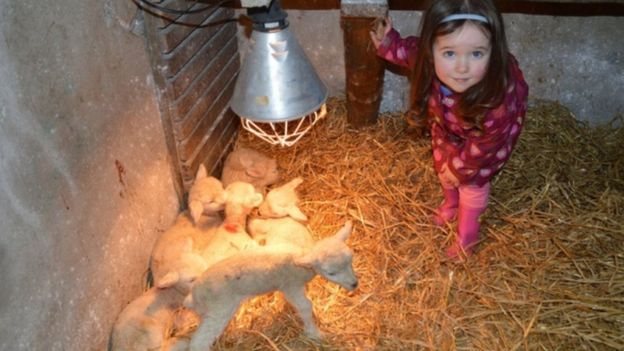
The daughter is as cute (maybe more) than the lambs! Rare case of sextuplets born to a Romney ewe in Ireland.
Sheep and goats typically have 2 udders although they may have more. More than 2 are considered a fault in pure breeds, particularly dairy breeds. Defies logic as cows have 4 (more is possible but a fault and are removed! if the cows are to be used for dairying) and only give birth to one or two calves at most while it is not rare for a sheep to have triplets. It is not rare for a few sheep breeds such as Finns to have quads but sextuplets are rare in any sheep breed.
Source: https://www.bbc.com/news/uk-northern-ireland-foyle-west-35941274
Generalized info. very nicely done! Angora goats have horns more similar to sheep in that they curl down but they are much thinner than sheep horns.

Source: https://hukkanaama.deviantart.com/art/Sheep-and-Goats-Learn-the-Difference-355012023

‘It’s been almost two years on from the birth of the sheep-goat hybrid.
‘ A farm in Kildare is home to the geep, who was born in March 2014. Owner of the farm Paddy Murphy said at the time that “it had all the hallmarks of a goat. He looks like a goat trapped in a lamb’s body.””
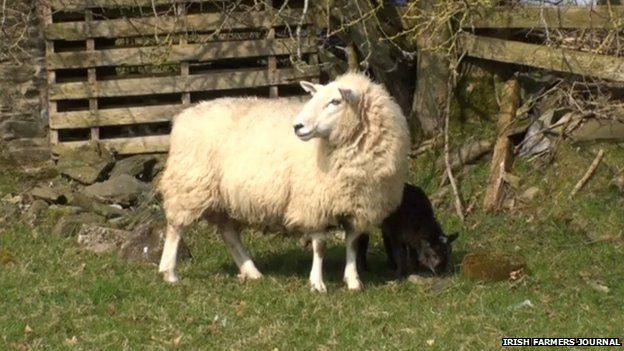
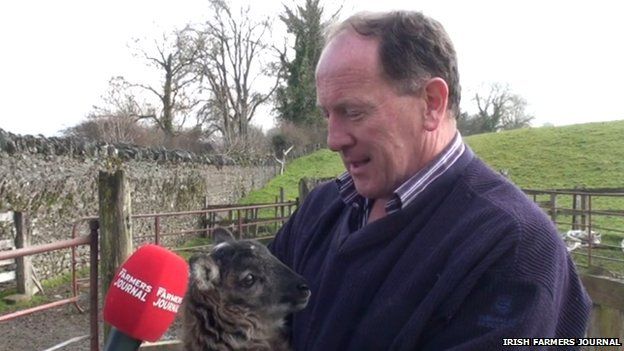
“I’ve never seem anything like him before,” he told the Irish Farmers Journal, adding that his family had been involved in sheep farming for “generations”.
Mr Murphy confirmed that the geep appeared to be healthy and “thriving” and was able to run faster than other lambs that were born around the same time.
“He’s unbelievable,” he said. “He’s so fast you’d have to get him into the pen to catch him. There’s no chance you would catch him otherwise.” ‘
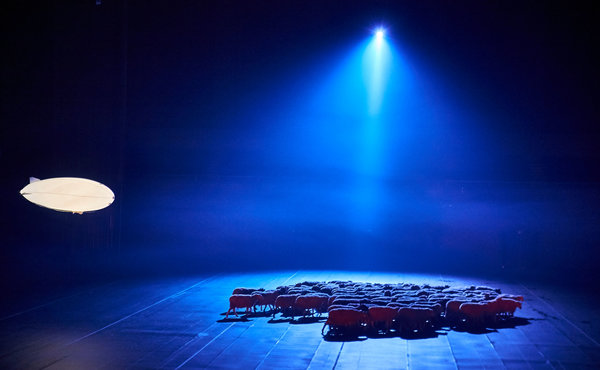
How do you cast and direct an avant-garde opera starring 100 sheep in New York City — in the middle of lambing season, no less?
Source: A New Breed of Opera Diva: Sheep
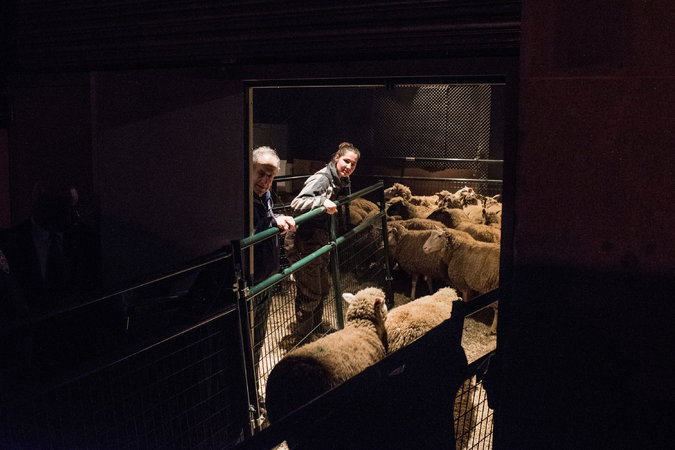
I posted the request for 100 sheep to our local group, the Garden State Sheep Breeders (GSSB), but thought they would have a hard time finding that many sheep willing to commute. Due to the cost of land in NJ and eastern PA most farmers in this area don’t have as many as 100 sheep. In addition the health requirements for bringing animals across state lines and into NY are expensive to meet. All animals must be inspected by a Vet and have a current rabies shot at a minimum. Think how much that would cost for 100 sheep! Not to mention the cost of transportation and housing. Additionally they could not be ready to lamb or have just lambed due to the potential for spreading Scrapies and this is the normal lambing season. Still I’m glad that Twin Brook Farm decided to go ahead with it as I’m sure it was an amazing sight. Only out West on a ranch would you typically get to see so many sheep together. It would be quite the experience for a city dweller, one that a small farmer would appreciate as well!
I’ve been weaving some samplers to explore techniques. Since my working looms are rigid heddle looms (a Mirrix tapestry loom and an Inkle loom) I’m focusing on using only two sheds. More intricate things can be done on these simple looms by adding pickup sticks but my poor vision makes me prone to threading mistakes so I’m working on getting the most out of simple methods. The sampler below explores color and weave. The patterns that can be created are nearly endless and use plain weave! The trick is in threading the warp with a color sequence and then following the same for the weft.
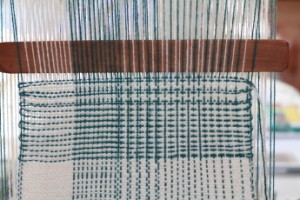
Color and Weave Sampler in Progress
I used green and white 100% wool mill ends at 10 ends per inch (epi). The warp was threaded as follows (left to right in photo):
20 ends white, 1 green 1 white 10 times (20 ends total), 2 green 2 white 5 times (20 ends total), 1 green 2 white 7 times (21 ends total), 1 green 3 white 5 times (20 ends). I also added 2 warp rows of green on each end for a selvage.
The weft followed the same pattern:
20 picks white,
20 picks total of 1 white and 1 green alternating,
20 picks total of 2 green followed by 2 white alternating,
21 picks total of 1 green followed by 2 white,
20 picks total of 1 green followed by 3 white.
This produces 25 blocks of patterns (5 wide x 5 high).
Initially I had a difficult time getting a good shed but after about 4 inches of weaving it finally started behaving. Wool is ‘sticky’ so it is tricky to use with a small epi in both warp and weft. Also, the green was not as strong as I would have liked so it was difficult to get good even tension across the warp. I made a few mistakes (!) but it will make a great reference for future weavings. I finished it using twisted fringes, the first time I have ever used this method. I bought a very economical fringe twister from Fiber Artist Supply. It made the job go quickly and it would have been difficult for me to do by hand due to my arthritis.
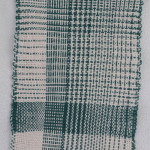
Color and Weave Sampler Off the Loom
In order to use up the rest of the warp on the loom (ie- not waste all that yarn and effort!) I created a Ghiordes knotted mini rug using BFL, Coopworth and Shetland fleece locks.
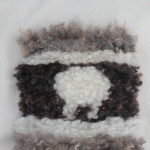
Ghiordes Knotted Mini Rug
It is done with all natural colors and so luxurious feeling. The length of the locks was quite different so the pile length varies. I did some trimming to remove “split ends” as I went along. The edges have 2 plain weave selvedges to keep the rug laying flat and there are 4 plain weave rows between knots of the shorter BFL and shetland locks (~2 inches), 8 plain weave rows between the much longer coopworth locks (~6 inches). The most time intensive part of the project selecting evenly sized locks from the fleece and organizing them to be pulled up quickly while weaving. I’ll definitely do more of these on a larger scale. Just need to develop a design. One more item for the to do list!
This is an older post (Oct. 2013) about the Rhinebeck Sheep and Wool Festival that I just saw but thought it was cute, inspirational and still so true! Enjoy.
21 Life Lessons you Learn at a Sheep Festival
In Scotland, “a runaway pet pig named Babe who thinks she is a sheep has set up home with a fleecy flock next door – evading capture for almost two weeks. Little Babe fled from her new home just moments after her owners’ trailer parked up at the smallholding they’d just moved to. This little piggy does not want to go home, living a life “on the lam with the sheep in a neighboring field, despite capture attempts by her owners.” Read the full story and short video at the Telegraph.

11-week old Babe, who thinks she is a sheep, hanging out with sheep and lambs on Miefield Farm, Twynholm, Dumfrieshire (Photo: SWNS) – included in the Telegraph article (By Claire Lomas, 4:35PM GMT 17 Mar 2016).
.
It’s available!


Photo: Kreuzschnabel/ Wikimedia Commons, Licence